
|
|
Anno Societatus XXXV
WARBOOK OF THE OUTLANDS
II. Table of Organization
IV. Commands and Tactics
V. Principles of Melee
VI. Legend
Second Edition Re-written and designed by Syr Darius of Jaxartes
Edited by Earl Joseph Cameron Blackswan, General of the Outlands Army
Proofing and diagrams by Master Adam Stedefast
The warbook is a field manual for the Army of the Outlands. This manual is to be used while training Outlands fighters in the art of war. Take it, use it and train so that you may join the ranks of the Outlands warriors. Its aim is to make all warriors skilled and practiced at familiar unit tactics so that we may work as one when it comes time for battle.
Outland warriors are fierce and strong, and our strength when combined, can become a deadly force. It is imperative that when in melee one knows and understands these basic commands. Knowing these tactics will not only save your life, but also that of your Outlands brother. A unit is more than two men, their definition and size can vary, but effective teamwork is the key. Two or twelve, a team is a team, and a good team always produces winners.
To be more effective we need to renew the power of the Outlands. Old and new fighters must rally together under one cause, one goal, and this goal is victory, and knowledge is our ally.
When the Outlands rallies for War, show your pride and colors. This will not only strike fear in the hearts of our enemies, but it will assist in field recognition and troop command. All local groups and fighters should attempt to wear Outlands colors when at war.
The art of war relies in the readiness of its army. Let it be known that the Outlands always stands ready.
II. ORGANIZATION
·King- Overall Commander of the Outlands forces and ultimate decision maker in all matters. The King may relinquish command to a General or Staff.
·General- Overall Commander of the forces at the King’s discretion. The General makes strategies, issues commands, plans the war effort, develops and initiates training programs, heads the Chain of Command and the War Council at the pleasure of the Crown.
·Warlord- Outlands army motivator and inspiration. The Warlord maintains high visual contact with the army, encouraging them and supporting them at their weakest moments.
·Regional Commanders- North, South, and Central Commanders. These three individuals will be responsible for on the field battle commands and discretionary troop movement under the direction of the General. The commanders are also responsible for developing and initiating training programs for their respective areas.
·Territorial Barons- Leaders of the appropriate units. May lead or relinquish leadership role to predetermined individuals. The Territorial Barons develop strategies as well as train and motivate their populace while maintaining communication with the Regional Commander and General.
·Thegns- On-the-spot unit based leaders. The Thegns support their units and make decisions concerning target acquisition and unit integrity.
·Stag’s
Bloods- On-the-spot squad based leaders. The Stag’s Bloods support
their commanders and maintain unit cohesion.
Basic Unit Tactics.
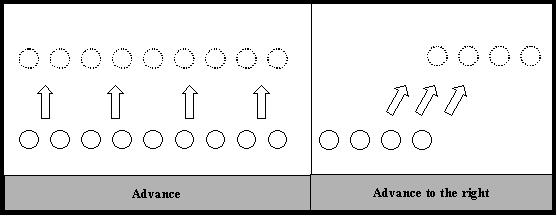
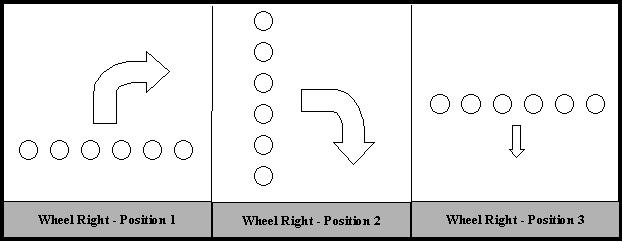
Form up - This is the basic command to form
our units and ready for combat. The command would sound "Outlands, Form
up!"



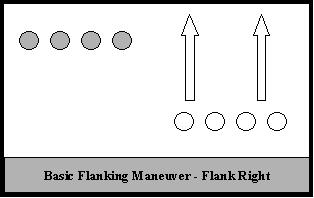
Flank - Left or right side of the opposing line, the unit moves
behind the enemy while engaging only when necessary. Outlands "Plan
A" involves a hard right flank followed by a counter-clockwise
sweep promoting deep penetration into the opponents backfield while pushing
the opponent forward trapping them between the sweeping forces and a static
or advancing front line. This strategy is also known as Hammer and Anvil.
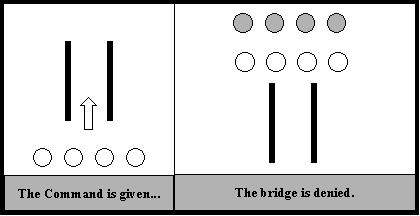
Deny - This command is actually two-fold - to take possession,
then defend. It comes typically with a place in mind and is meant for occupying
a position. On the command "Outlands Ready, Deny that Bridge, Move." The
unit would run out take the end of the bridge and deny the enemy possession
of it.
V. MELEE PRINCIPLES
INDIVIDUAL PRINCIPLES
These are standard practices within a melee combat. All fighters should know these concepts so that they may be a viable asset to the war effort. All fighters should be familiar with these principles before entering into the melee.
Hold- A hold is the command to cease fighting while maintaining a defensive posture. This is important due to the fact that missile fire or even individual combat may still be taking place. The fighter should repeat the phrase “HOLD!” and lower to one knee. Marshals will reinitiate combat when the area is clear. A hold should be called when an unsafe condition exists on the battlefield..
Killing from behind- When killing an opponent from behind, engage by closing and bringing your weapon into his view. With a sword, this can be done by reaching around and placing it in front of his grill. With a spear or two-handed weapon, place the weapon firmly on the opponent’s shoulder so he may see it in front of his face. At this time shout “You are dead from behind my lord.” Outlands warriors should also note that when killing from behind it is important to pick principal targets. (Excellent spearmen, elite knights, commanders, and archers are examples of principle targets).
Dying- After you have been killed on the melee field it is important to maintain safety at all times. Roll to one side, do not lay on your back or stomach. Draw knees up side to side but do not lay ankles flat across each other. Attempt to make no anvil like surfaces. Use your weapons and shield to cover vulnerable points. Stay still and listen for a command from the Marshall to clear the field. Outlands warriors should always fall to the ground when struck sufficiently.
Diagonal Defense- In a melee the opponent across from you may not always be your biggest threat. More often it is the spearman/poleman to your left or right, those who are diagonal from you. They wield the weapons that will find the gap in your defense. Therefore it is imperative that you can rely on your fellow warriors to either side for protection. This also means that you must do the same. Diagonal shots are deadly; you must watch for them and protect your Outlands brother from them. Foil the attack with weapon, shield or warning, but do not let it kill your comrade.
Barbecue- When our backfield has been penetrated, yell “Barbecue!” If you discover this by being killed from behind, make your dying breath a loud “I’m dead from behind!”
Target Acquisition- When in battle it is important to take out the most dangerous threats first. Spearmen, archers, warriors of excellent skill or leadership should all be priorities to dispatch. Point out dangerous opponents to commanders, kill these targets when coming in from behind, stop them from killing your comrades. Do not break a line or tactic to do so.
Leg em’ and leave em’- This tactic is to hit someone in the leg and do not follow up with combat. Leave them for clean up later. Do not sacrifice yourself or a maneuver trying to finish them off. This tactic is especially important when flanking.
Dead on the Ground- During combat some fighters may fall to the ground. To kill them without striking them you merely place a weapon on them, and say, “You are dead on the ground.” Make sure you kill fallen units in this manner as you pass them to prevent them from rising in your back field.
UNIT PRINCIPLES
These are the basic foundations of melee fighting. It is important that all fighters understand and use these. They follow SCA combat guidelines and will help Outlands fighters develop discipline and cohesion.
Dress- Dress is given to a unit when it needs to line up evenly. Dress right or dress left, the unit reacts to the specified side and lines up with even spacing.
At a Trot- When maneuvering, units may be told to move at a trot in order to quicken the advance. The unit should attempt to maintain cohesion and form as it moves at a quick pace to its designated location.
Charging- When charging the unit should move at a quick pace towards its goal. This is not a full speed maneuver until your are within three steps of the opponent. Therefore you would run, at a good pace, and then when met, power through into a sprint during the last three steps. Thus a three-step charge is initiated. Push through the line, do not pile up or slow down, impeding the process of those behind you. Shoot for gaps between shields, not the center of the shield itself.
High/Low- This tactic is usually employed with thrusting weapons, but can be used in any situation where two fighters are communicating well. In this instance one fighter would strike an opponent’s defenses either high or low, while an allied fighter would strike an instant later a correlating strike. Thus, if one fighter struck low, the other would strike high attempting to use the first impact to give them an open shot.
Weapon Catch- With this tactic a shield man can grab a hooking spear with the basket of his sword pinning it to the shield. This will cause attacking hooker to be out of sync with his weapon and may open him up to other attacks. Verbal communication with other spearmen is important to the success of this attack.
Disengaging Hook- During combat, pole arms may hook shields. In order to repel this attack, a fighter can push up, against the spear, with his basket hilt to dislodge the hook, or if a spearman is nearby, he can pry the hook off using his weapon as a lever. Avoid pulling away when hooked , thus breaking the shield wall and causing gaps to either side allowing for diagonal shots to be thrown by the enemy.
But still they come, they come for war.
Marching to fight yet another enemy.
Within their hearts each carries a weapon,
A blade of truth, skill, and bravery.
Heroes all, who know no fear,
It is their destiny to wage war for the Outlands.
Like mighty Thunderhead, and vicious Lightning,
Deadly blows rain down upon their enemies.
Horrid destruction bears its visage,
Yet for Outlanders this face is friend.
For this is their home, a battlefield of Death,
This is what fate holds for the Outlander.
Across bridges, over fields, through castles they charge,
Metal bites flesh and some slip from this world.
But they carry with them inner peace as they pass beyond,
For they know that while they die
Although this may be there last day,
Long shall live the Kingdom of the Outlands.
So it shall be, and so it always has been,
The Mighty Kingdom of the Outlands stands ready.
War is their cause, ready to die if they must,
It is for them the highest of all honors.
To fight with valor, courage, and honor,
And attain Victory for the Outlands.