|
|
This paper is the beginning of my personal notes. I am trying to examine the possibilities of SCA melee fighting and learn general principles. What you see here is what I consider important. I have tried soliciting comments on my work and received very little response. So I am no longer writing these pieces for a general audience, I am writing for me. This means I will no longer be taking any pains to explain what I consider to be basic concepts or the simpler aspects of reasoning that lead me to my conclusions. This is a work in progress and you are welcome to read it and I will answer questions as time allows but don't expect a custom tutorial from me. To get a better understanding of the basics, as I understand them, look at my Melee Tactics article. See also Duke Kein McEwan's article on melee tactics and Sir Scipio's article on limited front tactics.
This is a very generalized comparision between various possible formations for static, limited front battles. This analysis will look at three components: Shields, spears, and poles. I will not be looking at greatswords in any depth or florentine weapons at all because of their limited utility in these circumstances. Shields, spears, and poles form the core forces for melees of this type.
The analysis begins with an examination of the 'footprint' of each fighter. The Romans spaced their soldiers such that each soldier occupied an imaginary box 5' by 5'. [Actually, this is incorrect. I accepted the undocumented work of an online author. Publius Flavius Vegetius Renatus describes each Roman soldier as occupying a space three feet wide in his book 'Epitoma Rei Militaris'.] I have found (through personal experimentation) that, on average and in general, the minimum space required by each heavy fighter in the SCA is a 3' by 3' box. This box, which agrees with the box described by Vegetius, gives the fighter room to use a one-handed weapon, albeit in a fairly restrained manner. In the situations we are looking at this is generally compressed as fighters turn their bodies more perpendicular to the opposing line and eliminate shield gaps. This creates a 2' by 3' box which can be imagined as looking something like this:

Next we need to consider weapons range.
My experimentation and experiences lead me to the following conclusions:
| Shieldman | |
| Can comfortably strike out to approximately 3' in front of him. | |
| Preferred engagement range is two feet in front. | |
| Spearman | |
| Can comfortably strike out to approximately the length of his weapon (9') in front of him. | |
| Preferred engagement range is between 3' and 8' in front. | |
| Spear becomes unwieldy at ranges of less than 3'. | |
| Polearm | |
| Can comfortably strike out to approximately 7' in front of him. | |
| Preferred engagement range is between 3' and 6' in front. | |
| Poles are not limited to stabbing, they can move through the vertical arc as well | |
| Pole becomes unwieldy at ranges of less than 2' |
Obviously these numbers are very general and leave out all sorts of variables. Shieldmen, for instance, have different arm lengths and use different sword lengths. Shieldmen can also extend their range by fighting with their swordfoot forward (before or after they throw a blow). Spearmen can do likewise and both can take a single step forward. Consider these ranges to be minimums and that maximum range (which comes at the cost of defense) is something like 140% of the range given.
Because the maximum spear length allowed at Pennsic and Estrella is 9' I will not discuss 12' spears in this analysis.
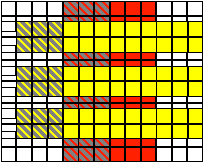
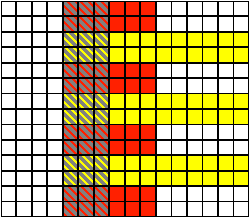
When we put this information together we can represent it graphically thus:

Fig. 2 Shieldman's footprint

Fig. 3 Spearman's footprint
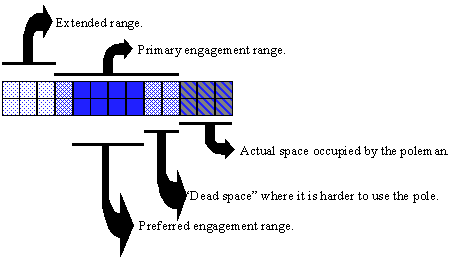
Fig. 4 Poleman's footprint
The solid colored boxes represent weapon range, the hatched boxes are the space actually occupied by the fighter, shaded boxes represent dead space or extended range. Dead space is area in which it becomes more difficult to hit targets or which require the fighter to emerge from his defense. With shieldmen, this space is at the end of the primary engagement range and my criteria was having to move the arm out in front of the shield. With spears and poles there are two areas. At the end of the primary engagement range where it is more difficult to target accurately and the weapon itself becomes somewhat exposed (to grabs and traps). At the beginning of the primary engagement range where the length of the weapon makes it difficult for the fighter to target opponents is the second area.
To my mind, spears and shields form the primary weapons systems for this type of battle. Shields are necessary to maintain the line and spears have the greatest killing range. All other weapons systems play a supporting role.
There are three basic ways to deploy
the two primary weapons systems together. Spears out front, spears
intermingled, or spears behind. We take the shields to be the basic
factor because they are the foundation of the battle line. Spears
may do most of the killing (they're supposed to) but shields maintain the
line. In the strictest sense the position of the line is determined
by where the shields are located. Therefore these formations are
described by the position of the spears relative to the battle line.
Graphically these formations look like this:
|
Just looking at these diagrams brings some interesting thoughts to mind. Each formation has the same number of fighters: 3 spearmen, 4 shieldmen. Putting the spears in front of or behind the shieldwall allows a commander to fit more people into a smaller front (this is one aspect of mass). The second thought revolves around the differences in engagement ranges. Putting the spears in front allows the spears to engage at maximum range, way outside the range of anything but another spear (or an archer). It makes them very vulnerable to a shield charge, however. Putting the spears behind the line protects them from shield charges, but cuts 6' off of their engagement range. |
Let's look at the matchups:
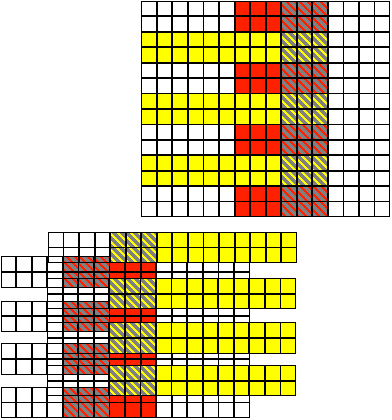
Fig. 8 Spears out front vs. Spears intermingled. |
In this instance count the number of people on each side. SF has 8 fighters (1 extra spear) to SI's 7 fighters. Why? Because the staggered formation of spears out front takes up less space on the line. This advantage could be increased still further if a non staggered formation was used. |

Fig. 9 Spears out front, non-staggered formation |
The problem inherent with the situation in figure 9 is that the spears have nowhere to go in the event of a charge by shields (or poles, or florentines). |
|
Note that the SB formation is even more compact than the SF. Because there aren't any spears in front of the shield wall, no space needs to be left for the spears to retreat through. This allows the shieldmen to be shoulder to shoulder with no gaps, creating a more compact line. On the other hand, this reduces the striking range of the spearmen and hampers their ability to target since they must work around (and over and under) the shield wall in front of them. In this case the SF can hit the opposing spearmen and shieldmen while still remaining out of reach of the opposing shieldmen. The SB formation has room for another shieldman in the line which can be useful because their formation is already pre-set to execute a charge. While the SF spearmen are scrambling to get behind the shields the SB spearmen and their supporting shieldmen are double-teaming the shieldmen in the SF formation. In figure 11 we see a bad situation. The SF spears are able to pick at the shieldmen of the SB line while they are out of range of the SB spears. |
|
In this matchup the SB formation has nine fighers to the opposition's 7 because of the formation tightness. The intermingled spears have a weaker defense, but more flexiblity because they don't have to work around the shieldwall. The SB formation is already setup for a charge or pulse charge in addition to having more shields and spears up front. In figure 13 we see the SB formation unable to strike at the SI formation while the SI spears can snipe away at the SB shields at will. |
If any of the formations is matched against itself then any tactical advantage confered by the formation is lost. At that point other factors (such as training, skill, numbers, morale, etc...) become the determining factors.
These formations are not set in stone. Any of the
variables can be changed to produce a new situation. Nor do the formations
need to be homogenous. You could combine elements of one formation
with another formation. Some of the possibilites are below.
|
In this example the SB formation
has been modified in several ways. To begin with, the shieldmen are
kneeling (as suggested by Tormod on the SCA Strategy
and Tactics board). This provides them with better defense (at
long range) and allows them to take up less space, reducing their footprint
to a 2' by 2' square. This allows the SB formation
to pack in 6 shieldmen to the 4 of the SF formation.
Another change is the positioning of the spearmen. The SB
formation has the spearmen standing a foot behind the shieldmen.
While this cuts a foot off their range it allows for the step-throw.
Step-throwing, for a spearman, involves bringing the rear foot forward
and twisting the body. Essentially this reverses the spearman's facing
and allows him to extend his rear arm (closest to the butt of the spear)
out in front of him (towards the opponents). This gives him another
3' (or so) of range. In the diagram this is represented by the shaded
yellow boxes. The orange boxes are overlap between spear and sword
ranges.
Is this useful? I don't see why not. As a long time shieldman I deplore kneeling during these types of fights because I know that some opposing shieldmen are going to get around to doing a pulse charge and club me like a baby seal over the gap above my head. It is still possible to advance the shield wall (albeit slowly) by having the shields move forward simultaneously. Calontir has used this concept to great effect by adding a second line of shieldmen who stand above and behind the front line of kneeling shieldmen. This protects the kneeling shieldmen and forms a crenellated wall for the spears to work from behind. See Pavel's article on early Calontir tactics for more information on this particular application. |

Fig. 16 A heterogeneous formation |
Here we see an example of a heterogeneous formation. Two of the spears are in front of the shieldwall (probably expert spearman) while a third is behind the line. The shieldwall is not uniform. On one end two shieldmen are shoulder to shoulder while the other end of the line has gaps for the spearmen to retreat through. While this formation does not maximize defensive or offensive abilities, it does provide a decent mix of the two. |

Fig. 17 A variation on a 'standard' formation |
Here is an example of a way in which a formation can be modified. [In truth there is no such thing as a "standard" formation. There are only concepts that can be applied to accomplish the task at hand.] The standard spears out front has been modified by closing the gaps between shieldmen and leaving a gap in the line for the spears to retreat through in the event of a charge. This is my rough interpretation of a formation described in Sir Tarrach Ulfson's Memoirs of a Northshield General (and why don't we see more of this sort of writing?). This interpretation lacks the out front shield team (2 men) who were responsible for breaking up/delaying any charges by the oposition. In my opinion this formation maximizes defense but hinders offense. The shields are unable to execute a snap pulse charge because the spears are in their way (although the right side of the line would be a good place to bring up troops and initiate a column charge). On the other hand, this method is easier to use with un-trained troops (the bulk of the SCA) and is fairly robust (when the shield wall starts taking casualties this formation will stand up to it better). |
Rock, Paper, Scissors
The classic Rock, Paper, Scissors game is sometimes used to illustrate the idea that no formation is perfect for all things. The Northshield War Manual and a third hand discussion which attributed its information to Sir Dongal of Calontir are my sources for this information. Rock = A stationary shieldwall, Paper = Spears, Scissors = A shield charge. Using this analogy: Rock blunts Scissors, Scissors cuts Paper, Paper covers Rock.
For a stationary shieldwall, spears behind:
Bring up spears to pick them apart.
Be prepared to retreat your spears
and have your shields deal with a pulse charge.
For spears upfront:
Have your shields charge (full or
pulse) and restablish the line at 4' to 6'
This will
prevent the spears from coming out front again unless they retreat their
shieldwall.
If the shieldwall retreats, advance to maintain distance.
For spears intermingled:
Bring spears up (more than they have)
to pick them apart with a greater volume of fire.
Be prepared to retreat your spears
and have your shields deal with a pulse charge.
-or-
Bring your shield wall to close range (4') and let your superior number of spears behind the line do their work.
-or-
Charge.
Great Weapons and Poles
Great weapons and poles support the shields (while the shields support the spears and the spears do most of the offensive killing). Great weapons have a shorter range than polearms, but they are easier to use in close. Great weapons and poles typically are located behind or, occasionally, intermingled with the shields. They are almost never brought out in front of the shieldwall (if you compare the ranges in figure 5 you will see that poles or great weapons in front of a shield wall must be in the range of the opposing spears in order to get within range of the opposing shields). When the range becomes too close for spears to be effective then poles and great weapons come into their own.
Let's look at a hypothetical idea for a bridge battle. We will assume that the intial clash is over. Both sides have already sent their intial rush of shields down the bridge and steady lines have been established. The opponents have control of the midpoint and are content to fight a defensive battle. So we will send our spears forward to attrit/bleed them. Our formation will look something like this:

Fig. 18
Where the yellow circles are spears, the blue circles are shields, and the green cicles are poles/great weapons. Note the movement corridors to allow the spearmen to retreat behind the shields and the movement corridors to allow reinforcements to come up to the front and tired fighters to retreat to the rear for a rest (Figure 19). This arrangement is a modified version of "Plan Beta" as described in Duke Kain McEwan's article on melee tactics. Note also the similarity between this formation and the gatekeepers concept in Beornmann on Ceaster's article on Small Unit Techniques for SCA Melee Combat. I prefer to have gates rather than gatekeepers primarily because I dislike the idea of having shieldmen stepping backwards while the opponent is charging. As you will see, the second rank shieldmen move forward as the spears move back. I readily admit that this is nothing more than a personal preference.

Fig. 19 Movement lanes
The spears are now responsible for doing all of the killing. If a spearman gets tired he can move to the rear and let a fresh spearman from the reserves move up to take his place. Our opponents now have three choices: 1) stand and take it, either hunkering down or bringing their own spears forward for a spear duel, 2) close the range to bring their spears (behind or intermingled with their shieldwall) into play, or 3) charge (either full-fledged or a pulse). What happens if they pulse? Consider a possible sequence outlined below.

Fig. 20 Opponent begins to charge
When the opponent begins to charge the spears turn around and run back behind the shields. The shields move up and step over to their right so that they are directly in the line of anyone who might be running down a spearman. This is important. Spearmen must know that their back is protected or they will refuse to turn and run. They will try to withdraw gradually (walking backwards) and this will allow the opponent to close to contact before the shieldwall is formed (as well as cause confusion in our line as the spearment hinder the forward movement of shields and poles). Lack of trust will get the entire battleline killed.

Fig. 21 The shieldwall forms
The first line of shields stops and fixes themselves while the second line of shieldmen advances and fills the gaps created when the first line stepped right. The spearmen continue to retreat down the center, clearing space for the poles to advance.

Fig. 22 The poles advance to support the shields
The spears get out of the way and the poles advance to support the shieldwall. The shieldwall stops the advance of the opponent and stays alive. A moment later the poles arrive and begin to hammer the opponent.

Fig. 23 A new line has formed
The spears now turn and add their support, killing in the second and third ranks of the opponent's formation to rip the heart out of the charge.
There are any number of options available at this point. If the opponent has sufficient forces to hold the space they have gained then we can re-establish our line a little further back. Reserve forces create a new line while the shields and poles of the original battleline filter back into the reserves under covering fire from the spears. Like this:

Fig. 24
While this may seem like a defeat, remember our goal. We are trying to attrit the opponent. If we did everything right then our opponent lost more men than us (hopefully they lost lots and we lost none). When they are sufficiently weakened we can switch over to a tactical offensive and retake lost ground. If we had wanted to hold ground then we could have kept the new battleline and slugged it out until the opponent pulled back. A counter charge (pulse, general, or column) would help to speed this process up.
Another option is to create a kill pocket. A kill pocket is a concave line pointed towards the opponent with shields in front and spears behind. That central movement corridor in our formation is a natural kill pocket waiting to happen. Just let the opponent push the center back a little to bow the line and bring up more spears from the reserve and voila, kill pocket. A kill pocket is very useful for 'capping' a bridge or sealing a gap. If you are unable to hold a bridge you can form a kill pocket at the end of it. Unless your opponent has many more or much better troops than you he will be stuck. The only way to engage your forces is to advance into your kill pocket (where they will take more casualties than they inflict upon you).

Fig. 25 A basic kill pocket
If, back at figure 18, our opponent had chosen to simply stay put we could have bled them until we had numerical superiority and then mounted a charge with fresh troops (brought up from the reserves) to push them back.
No one has yet commented on the similarity
of my proposed formation to the battle formations of Roman legions.
I confess it came as a surprise to me as well.